
A screenshot made the rounds this week: the LinkedIn profile of Apple's incoming CEO, and it's almost entirely empty.
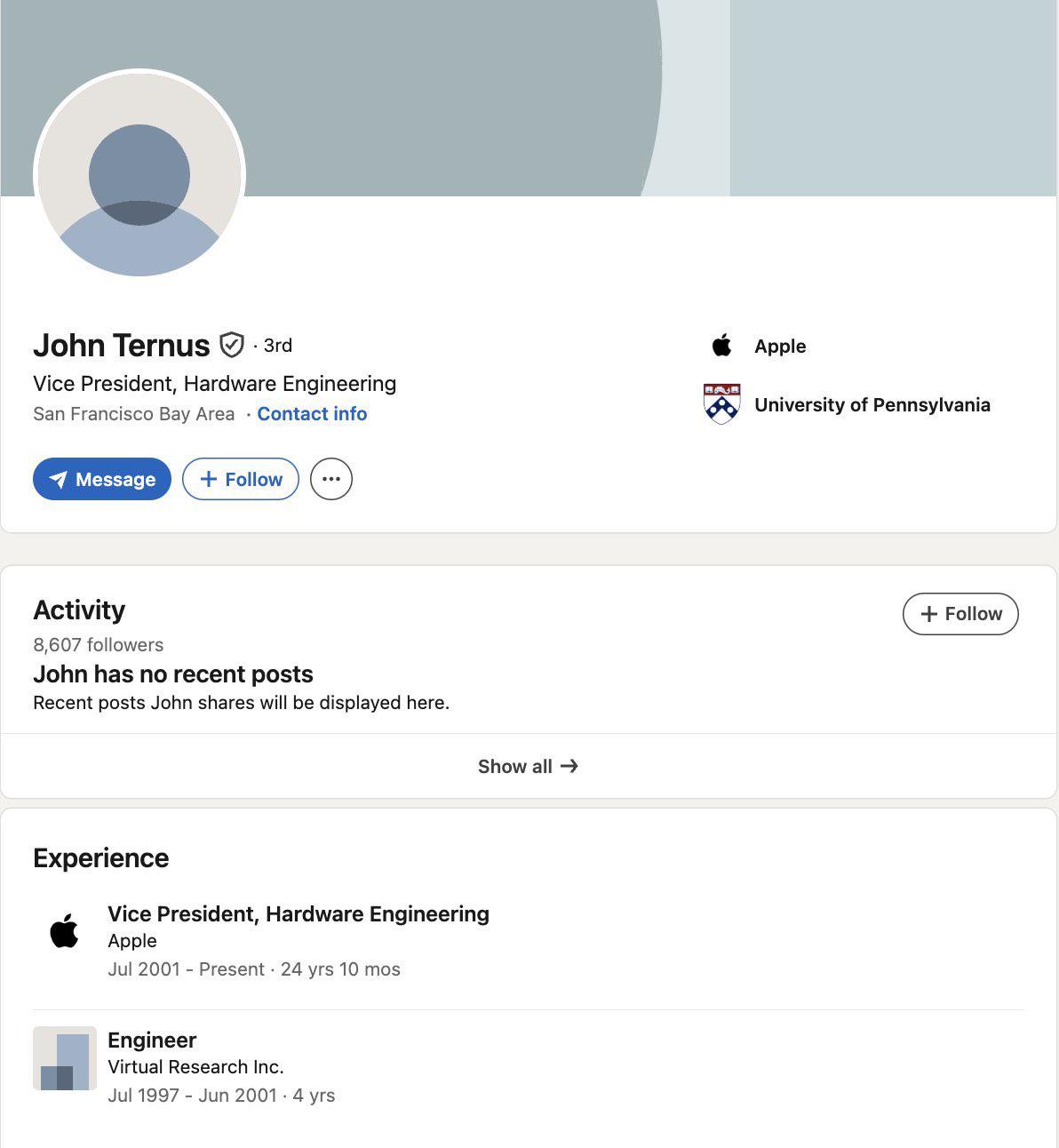
Two roles, total. He spent four years as an engineer at Virtual Research Inc. starting in 1997, and has been Vice President of Hardware Engineering at Apple since July 2001, which will hit 25 years this summer. There's nothing in the Articles section, nothing in the Posts section, and he apparently never got around to uploading a real photo - the profile picture is still LinkedIn's default gray silhouette. His follower count, at the moment this screenshot was taken, sits at 8,607 - the kind of number a mid-career recruiter might hit on a slow year. By the time you read this, that number is probably much higher, because being publicly named as Apple's next CEO is going to pull a lot of traffic through the profile whether he wants it or not. The snapshot is what matters, though: until the announcement, this was the profile of one of the most important hardware people in the industry, and almost nobody was following it. Under "Activity," LinkedIn's own interface ends up apologizing on his behalf: "John has no recent posts. Recent posts John shares will be displayed here."
The reaction everywhere was the same phrase, repeated thousands of times: normalize this.
That reaction is doing a lot of work, and most of it isn't about one man's profile. It's about LinkedIn itself, and about what developers keep getting told they need to do on it. The advice is always some flavor of the same thing - post more, show up, write thought leadership, build your personal brand, announce every launch and every promotion and every half-formed opinion about AI before the algorithm loses interest in you. Be visible, be active, be "on the radar." And for years I've quietly suspected that advice has the correlation backwards.
The inverse rule nobody wants to say out loud
The people who post the most on LinkedIn are rarely the people shipping the most. The ones with the packed Activity feed, six posts a week, ten "repost with a comment" entries every morning, endless excited to announce and thrilled to share, are almost never the people you'd want building your product. They're usually selling something, and the thing they're selling is most often themselves - a newsletter, a course, a consulting practice. Very rarely is the thing they're selling a piece of software that actually works.
Then there's the other group, the one that's harder to find on LinkedIn because the feed isn't really built for them. They're heads down, shipping features and fixing bugs and talking to maybe three people on any given day. Their LinkedIn is a thing they touched in 2019 and then forgot about, which is why the photo is outdated, the title is one role behind, and the posts section sits empty - because the work that would theoretically generate those posts is the thing they've been too busy doing.
The cleanest one-line diagnosis of the whole Ternus screenshot, the take that kept surfacing on every thread:
It's almost as if he's actually busy working each day.
A VP of Hardware Engineering at Apple for more than a decade does not need to sell himself. His work does that for him. Every Mac review, every iPhone launch, every Apple Silicon benchmark is functioning as his résumé in real time. He was part of the team that made it possible for Apple to cut Intel out of the Mac, a thing people said couldn't be done without a generational step backward in performance - right up until the M1 shipped and the reviews came in. There is, effectively, more signal about who this person is from ten years of shipped products than any amount of "5 leadership lessons I learned from my morning coffee" could ever generate. Compare that to someone who's been posting carousel infographics titled "7 things every CTO needs to know" for three years straight, and the question answers itself.
The pushback always comes fast when I say something like this. LinkedIn got me a job. LinkedIn got me three recruiter calls last month. LinkedIn pays my rent. Fair enough - I'm not arguing LinkedIn is useless. For a lot of people, especially early in their careers, it's a real tool. Recruiters live there, hiring managers check it, and a profile with your current role, a short summary, and some actual work attached is a reasonable thing to have. I have one. Most developers should have one. Going completely invisible on LinkedIn can genuinely hurt you in industries where the hiring motion starts with a recruiter's keyword search in Sales Navigator.
What I'm arguing against is a different thing. It's the idea that LinkedIn presence - the posts, the likes, the comments, the performance of having a personal brand - is what makes you a serious professional. That's the part that turns into theater. Having a LinkedIn as a lightweight CV that recruiters can pull up is fine; living on LinkedIn is a red flag, because the difference between treating the platform like a phone book and treating it like a stage tends to show up in your output within a month or two. An empty profile, in this framing, isn't really a gap. It's the absence of performance, and on a platform that runs almost entirely on performance, absence ends up being a stronger signal than any amount of presence could be.
The artifact test
Developers have a parallel trap, and it goes by a much nicer name: "build in public." I've bought into this one, partially. I write blog posts, I share what I learn, two of my posts have made it to the front page of Hacker News, and one got picked up by a newsletter with over a million readers. I'm not pretending I'm above any of this. But I've noticed a distinction in the category that doesn't get talked about much, which is that building in public is not the same as performing work in public.
Building in public looks like this: here's the thing I made, here's what I learned while making it, here's the link to the code if you want to pull it apart yourself. It's specific, it's falsifiable, and if I tell you I built something, you can click on the link and see whether I actually did. Performing work in public, on the other hand, looks like this: "Super proud to announce our latest initiative to empower collaboration across the organization." There's no artifact anywhere in the sentence, no proof, no link to anything you can click and evaluate - just the theater of having done a thing, with none of the thing itself. The first kind of post is useful to me, to whoever reads it, and sometimes to a recruiter who stumbles onto the archive. The second kind is slop, and LinkedIn's feed is tuned to reward it precisely because it costs nothing to produce and keeps people scrolling long enough for an ad to load.
The empty-LinkedIn guy at Apple passes the artifact test without trying. You can hold the artifacts in your hand - the M-series MacBook, the iPad, the Vision Pro - and no amount of thought leadership could substitute for that as evidence of competence. For the rest of us, the test works the same way, just at a smaller scale. Is there something you can point to that exists outside of a LinkedIn post? A repository, a live site, a blog post that teaches someone how to do a specific thing, a product with a URL and at least one paying customer? That's the work, and everything else is mostly costume.
None of this means you should delete your LinkedIn. Keep the profile, update the title when it changes, add the projects you'd actually brag about to a friend over coffee, and let recruiters find you - that's tool use, and tools are fine. But the next time I feel that low-grade guilt about not having posted in a week, about "falling behind" the people out there grinding their personal brand every morning before standup, I'm going to remember the screenshot. A profile that hadn't been touched in years, two jobs across roughly thirty of them, a placeholder avatar, and 8,607 quiet followers - and the verdict the entire internet landed on in the same breath.
Normalize this. The best builders are usually too busy building to tell you they are.